Spitfire Mk I Performance Testing

Aeroplane and Armament Experimental Establishment
Martlesham Heath
Handling trials of the Spitfire K.5054
SUMMARY OF FLYING QUALITIES
The aeroplane is simple and easy to fly and has no vices. All controls are entirely satisfactory for this type and no modification to them is required, except that the elevator control might be improved by reducing the gear ratio between the control column and elevator. The controls are well harmonised and appear to give an excellent compromise between manoeuvrability and steadiness for shooting. Take-off and landing are straightforward and easy.
The aeroplane has rather a flat glide, even when the undercarriage and flaps are down and has a considerable float if the approach is made a little too fast. This defect could be remedied by fitting higher drag flaps.
In general the handling of this aeroplane is such that it can be flown by the average fully trained service fighter pilot, but there can be no doubt that it would be improved by having flaps giving a higher drag.
Aeroplane and Armament Experimental Establishment
Martlesham Heath
Spitfire K.9787
Merlin II
Fixed pitch wooden airscrew
Performance Trials
Results of Trials
A comparison is made in the table below between this production aeroplane and the prototype K.5054.
| Prototype K.5054 | Production K.9787 | |
| Maximum speed | 349 at 16800 | 362 at 18,500 ft. |
| Maximum cruising speed (at 15,000 ft.) | 311 m.p.h. | 318 m.p.h. |
| Time to 15,000 ft. | 5.7 mins. | 6.5 mins. |
| Time to 30,000 ft. | 17.0 mins | 22.4 mins |
| Service ceiling | 35,400 ft. | 31,900 ft. |
| Weight | 5332 lb. | 5819 lb. |
| Height ft. | T.A.S. m.p.h. | Time From Start Min. | Rate of Climb Ft./Min. |
|---|---|---|---|
| Sea Level | 0 | 2090 | |
| 2,000 | 295 | 1.0 | 2195 |
| 5,000 | 307 | 2.3 | 2295 |
| 10,000 | 328 | 4.3 | 2490 |
| 11,000 | 4.8 | 2530 | |
| 15,000 | 348 | 6.5 | 2065 |
| 16,500 | 355 | 7.2 | 1890 |
| 18,000 | 361 | 8.1 | 1710 |
| 18,500 | 362.5 | ||
| 20,000 | 360.5 | 9.4 | 1480 |
| 25,000 | 349 | 13.6 | 900 |
| 30,000 | 315 | 22.4 | 325 |
| Service ceiling = 31,900 ft. | |||
| Flying weight on trials = 5819 lb. | |||
Aeroplane and Armament Experimental Establishment
Martlesham Heath
Spitfire K.9787
Merlin II
Fixed pitch wooden airscrew
Fuel Consumption tests, handling and diving trials
Weight Normal Load 5804 lb.
| OPERATIONAL HEIGHT:- 15,000 FT. WEIGHT BEFORE FLIGHT:- 5804 lb. TYPE OF FUEL USED:- D.T.D. 230. | SPECIFIED CRUISING SPEED ESTIMATED MEAN WEIGHT:- SPECIFIC GRAVITY OF FUEL AT 60°F:- 0.75 | |||||||
| I.C.A.N. Height ft. | AIR SPEED m.p.h. | R.P.M. | Boost Pressure lb/sq.in. | Mixture Control | Consumption (S.G. .75) | Statue Air Miles Per Gall. | ||
|---|---|---|---|---|---|---|---|---|
| True | A.S.I. | lb/Hr. | Galls/Hr. | |||||
| 7000 | 200 | 184.5 | 1770 | -4.3 | Auto Weak | 181 | 24.1 | 8.3 |
| 220 | 204.5 | 1895 | -3.0 | " | 200 | 26.65 | 8.26 | |
| 240 | 224 | 2020 | -1.6 | " | 231 | 30.8 | 7.8 | |
| 260 | 243.5 | 2155 | 0 | " | 275.5 | 36.75 | 7.08 | |
| 280 | 261.5 | 2300 | +1.9 | Auto Rich | 409 | 54.5 | 5.14 | |
| 300 | 280 | 2440 | +3.8 | " | 466.5 | 62.2 | 4.83 | |
| 322 | 300 | 2600 | +6.0 | " | 591 | 78.8 | 4.09 | |
| Most economical cruising speed is approximately 200 m.p.h. A.S.I. At this speed the aeroplane is fully controllable. | ||||||||
Weight Normal Load 5804 lb.
| OPERATIONAL HEIGHT:- 15,000 FT. WEIGHT BEFORE FLIGHT:- 5804 lb. TYPE OF FUEL USED:- D.T.D. 230. | SPECIFIED CRUISING SPEED ESTIMATED MEAN WEIGHT:- SPECIFIC GRAVITY OF FUEL AT 60°F:- 0.75 | |||||||
| I.C.A.N. Height ft. | AIR SPEED m.p.h. | R.P.M. | Boost Pressure lb/sq.in. | Mixture Control | Consumption (S.G. .75) | Statue Air Miles Per Gall. | ||
|---|---|---|---|---|---|---|---|---|
| True | A.S.I. | lb/Hr. | Galls/Hr. | |||||
| 15,000 | 220 | 179 | 1975 | - | Auto Weak | 202 | 26.9 | 8.18 |
| 240 | 197.5 | 2090 | -3.9 | " | 218 | 29.1 | 8.26 | |
| 260 | 214.5 | 2220 | -2.6 | " | 242 | 32.25 | 8.06 | |
| 280 | 232 | 2345 | -1.3 | " | 277.5 | 37.0 | 7.56 | |
| 300 | 249 | 2485 | +0.3 | " | 325.5 | 43.4 | 6.91 | |
| 317 | 262.5 | 2600 | +1.7 | " | 377 | 50.3 | 6.3 | |
| Most economical cruising speed is approximately 200 m.p.h. A.S.I. At this speed the aeroplane is fully controllable. | ||||||||
Aeroplane and Armament Experimental Establishment
Martlesham Heath
Spitfire K.9793
Merlin II
Short Performance with 2 pitch metal airscrew
Summary of Results
The take-off is much improved over that with the wooden airscrew, and the maximum speed is increased from 362 m.p.h. with wooden airscrew to 367 m.p.h. with the 2 pitch metal airscrew. The climb performance with metal airscrew is also better considering the increase in weight.
| Height ft. | T.A.S. m.p.h. | Time From Start Min. | Rate of Climb Ft./Min. |
|---|---|---|---|
| 2,000 | 1.29 | 1625 | |
| 5,000 | 3.0 | 1845 | |
| 9,700 | 5.4 | 2175 | |
| 10,000 | 5.5 | 2150 | |
| 15,000 | 8.1 | 1725 | |
| 16,500 | 358.5 | 8.9 | 1600 |
| 18,000 | 365 | 9.9 | 1475 |
| 18,600 | 367 | ||
| 20,000 | 366 | 11.4 | 1305 |
| 23,000 | 14.0 | 1055 | |
| 26,000 | 17.2 | 800 | |
| 28,000 | 20.0 | 630 | |
| 30,000 | 23.8 | 470 | |
| Service ceiling (Estimated) = 34,400 ft. | |||
| Flying weight on trials = 5935 lb. | |||
Aeroplane and Armament Experimental Establishment
Martlesham Heath
Spitfire L.1007
Merlin III
Handling and performance trials with two 20 m.m. cannon fitted
The aeroplane is fitted with a 2-pitch 3-blade metal airscrew and it was desired to compare the handling and the performance of the aeroplane with that of Spitfire K-9793, fitted with Browning guns and 2-pitch metal airscrew.
Summary of Trials
| Height ft. | T.A.S. m.p.h. | Time From Start Min. | Rate of Climb Ft./Min. |
|---|---|---|---|
| 2,000 | 1.0 | 1970 | |
| 5,000 | 2.5 | 2040 | |
| 10,000 | 4.9 | 2170 | |
| 13,000 | 339 | 6.4 | 1920 |
| 15,000 | 348 | 7.5 | 1750 |
| 16,500 | 354.5 | 8.4 | 1620 |
| 18,000 | 360.5 | 9.3 | 1490 |
| 18,600 | 364 | ||
| 20,000 | 362.5 | 10.7 | 1320 |
| 23,000 | 359 | 13.2 | 1070 |
| 26,000 | 354 | 16.4 | 820 |
| Service ceiling = 34,500 ft. | |||
| Flying weight on trials = 5925 lb. | |||
Aeroplane and Armament Experimental Establishment
Boscombe Down
Spitfire N.3171
Merlin III
Rotol Constant Speed Airscrew
Comparitive Performance Trials
In accordance with Air Ministry letter, reference B.9242/39/A.D./R.D.L. dated 4th November 1939, performance trials have been carried out to compare this aeroplane with the standard Spitfire I fitted with a 2-pitch airscrew.
Summary of Trials
| Height ft. | T.A.S. m.p.h. | Time From Start Min. | Rate of Climb Ft./Min. |
|---|---|---|---|
| 2,000 | .7 | 2,820 | |
| 5,000 | 1.8 | 2,850 | |
| 10,000 | 320 | 3.5 | 2,895 |
| 11,000 | 3.9 | 2,905 | |
| 15,000 | 339 | 5.4 | 2,430 |
| 18,900 | 354 | ||
| 20,000 | 353.5 | 7.7 | 1,840 |
| 25,000 | 345 | 11.0 | 1,250 |
| 30,000 | 319 | 16.4 | 660 |
| Service ceiling = 34,700 ft. | |||
| Rate of Climb, Time & Boost to Height |
| Level Speeds & Boost at Heights |


N.3171 weighed in at 6,050 lbs. The 73 lb. pilot's armour found on more mature Spitfire Is was lacking. The aircraft was slightly down on power effecting top speed by about 2 mph. The engine limitations for the tests were:- Level Speeds - All-Out 5 minutes limit - 6.25 lbs./sq.inch, 3000 RPM; Climb - 6.25 lbs./sq.in. 2600 RPM Climbing 1/2 hour limit. Ironically, the day after this report was issued >AP1590B/J.2-W was released, increasing the engine limitations to +12 lbs./sq.in, 3000 RPM. This allowed for an >increase in speed below 10,000 feet of 28/34 mph.


Aeroplane and Armament Experimental Establishment
Boscombe Down
Comparison of Performance of Rotol and DH Airscrews on Spitfire
Both the aircraft are similar externally and are fitted with bullet proof windscreen and armour plating over the tank, etc. Aircraft R6774 is fitted with DH airscrew and N3171 with Rotol airscrew. It will be noted that these aircraft are about 12 miles an hour down in speed against the previously tested K9793, but the relative comparison remains. This loss in speed is accounted for, by 6 miles an hour for the bullet proof windscreen and 6 miles an hour due to loss in engine power.
Level Speed miles per hour.
| Aeroplane | Altitude Feet | ||||
|---|---|---|---|---|---|
| 14000 | 16000 | Max. speed | 20000 | 22000 | |
| R6774 | 342 | 349 | 355 @ 17,800' | 350 | 341 |
| N3171 | 336 | 343 | 354 @ 18,900' | 354 | 352 |
The above tests were all carried out using 87 octane fuel with boost limited to +6.25 lbs./sq.in.
Climb figures were achieved using the 2600 rpm 1/2 hour climb limit.
By the Battle of Britain all operational squadrons had changed over to 100 octane fuel and
the engine limits on the Spitfires had been increased to +12 lbs./sq.in. 3,000 rpm with 1/2 hour climb limit increased to 2850 - 3000 rpm.
Royal Aircraft Establishment figures for a Spitfire I using +12 lbs/sq. in. boost are 314 mph at Sea Level and 359 mph at a full throttle height of 11,500 feet.


Aeroplane and Armament Experimental Establishment
Boscombe Down
Spitfire I X.4257 and R.6770.
Merlin III
(2 cannons and 4 Browning Guns.)
Brief Performance and Handling Trials
Brief performance and handling trials were required on a Spitfire fitted with 2 cannons and 4 Browning guns. The tests were made on two aeroplanes Spitfire I X.4257 and Spitfire I R.6770.
Summary of Trials
| Height ft. | T.A.S. m.p.h. | Time From Start Min. | Rate of Climb Ft./Min. |
|---|---|---|---|
| 2,000 | 0.9 | 2,295 | |
| 5,000 | 2.1 | 2,350 | |
| 10,000 | 331 | 4.3 | 2,360 |
| 11,400 | 4.9 | 2,370 | |
| 15,000 | 348 | 6.6 | 2,020 |
| 18,000 | 358 | 8.2 | |
| 20,000 | 353 | 9.4 | 1,535 |
| 25,000 | 13.2 | 1,050 | |
| 30,000 | 19.6 | 570 | |
| Service ceiling = 34,700 ft. | |||
| Summary of Trials |
| Rate of Climb, Time to Height, & Boost |
| Level Speeds and Boost at Height |


Aeroplane and Armament Experimental Establishment
Boscombe Down
Messerschmidt 109 Fighter
Brief Handling Trials
Conclusions
In general flying qualities the aeroplane is inferior to both the Spitfire and the Hurricane at all speeds and in all conditions of flight. It is much inferior at speeds in excess of 250 m.p.h. and at 400 m.p.h. recovery from a dive is difficult because of the heaviness of the elevator. This heaviness of the elevator makes all manoeuvres in the looping plane above 250 m.p.h. difficult including steep climbing turns. No difference was experienced between climbing turns to the right and left. It does not possess the control which allows of good quality flying and this is particularly noticeable in acrobatics.
Royal Aircraft Establishment at Farnborough
Spitfire IA K.9791 with Rotol constant speed propeller
Me 109E-3 Werk-Nr 1304
Comparitive trials between the Me.109 and "Rotol" Spitfire.
1. The trial commenced with the two aircraft taking off together, with the Spitfire slightly behind and using +6 1/4 lb boost and 3,000 rpm.
2. When fully airborne, the pilot of the Spitfire reduced his revolutions to 2,650 rpm and was then able to overtake and outclimb the Me 109. At 4,000 ft, the Spitfire pilot was 1,000 feet above the Me 109, from which position he was able to get on its tail, and remain there within effective range despite all efforts of the pilot of the Me 109 to shake him off.
3. The Spitfire then allowed the Me 109 to get on to his tail and attempted to shake him off this he found quite easy owing to the superior manoeuvrability of his aircraft, particularly in the looping plane and at low speeds between 100 and 140 mph. By executing a steep turn just above stalling speed, he ultimately got back into a position on the tail of the Me 109.
4. Another effective form of evasion with the Spitfire was found to be a steep, climbing spiral at 120 mph, using +6 1/4 boost and 2,650 rpm; in this manoeuvre, the Spitfire gained rapidly on the ME 109, eventually allowing the pilot to execute a half roll, on to the tail of his opponent.
5. Comparitive speed trials were then carried out, and the Spitfire proved to be considerably the faster of the two, both in acceleration and straight and level flight, without having to make use of the emergency +12 boost. During diving trials, the Spitfire pilot found that, by engageing fully coarse pitch and using -2lbs boost, his aircraft was superior to the Me 109.

Royal Aircraft Establishment, Farnborough
Messerschmitt Me.109.
Handling and Manoeuvrability Tests
Conclusions
Take off is fairly straightforward. Landing is difficult until the pilot gets used to the aeroplane.
Longitudinally the aeroplane is too stable for a fighter. There is a large change in directional trim with speed. No rudder trimmer is fitted; lack of this is severely felt at high speeds, and limits a pilot's ability to turn left when diving.
Aileron snatching occurs as the slots open. All three controls are far too heavy at high speeds. Aerobatics are difficult.
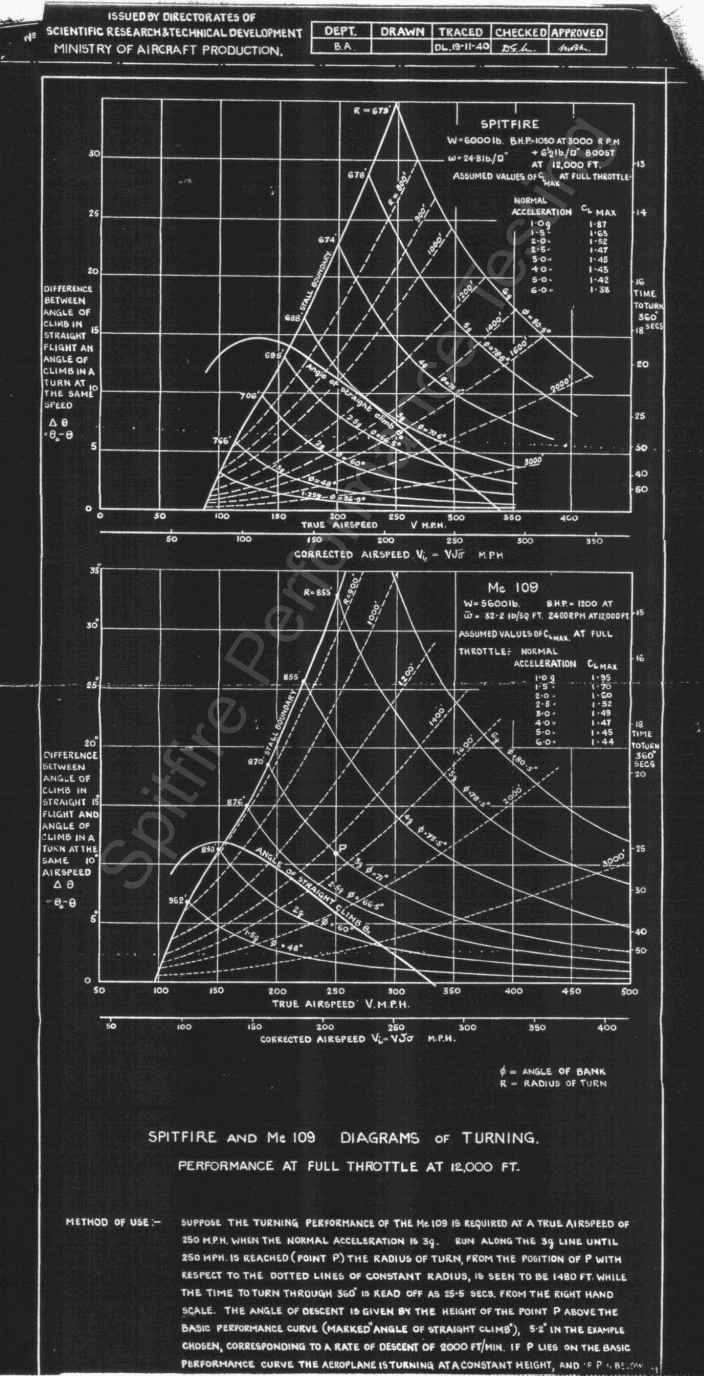
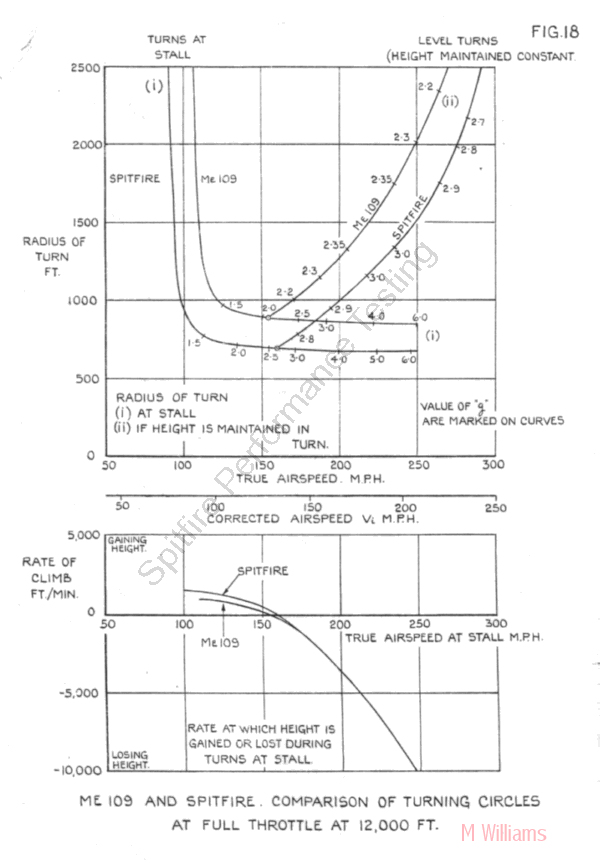
The Me 109 is inferior as a fighter to the Hurricane or Spitfire. Its manoeuvrability at high speeds is seriously curtailed by the heaviness of the controls, while its high wing loading causes it to stall readily under high normal accelerations and results in a poor turning circle.
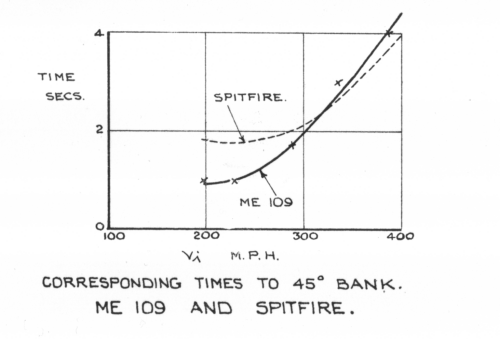
At 400 m.p.h a pilot, exerting all his strength, can only apply 1/5 aileron, thereby banking 45 deg. in about 4 secs. From the results Kb2 for the Me 109 ailerons were estimated to be -0.145.
The minimum radius of turn without height loss at 12,000 ft., full throttle, is calculated as 885 ft. on the Me 109 compared with 696 ft. on the Spitfire.
Turns at minimum radius without height loss.
Both aeroplanes at full throttle at 12,000 ft.
| Spitfire | Me.109 | |
|---|---|---|
| Minimum radius of turn without loss of height. ft. | 696 | 885 |
| Cooresponding time to turn through 360 deg. sec. | 19 | 25 |
| Indicated airspeed Vi m.p.h. | 133 | 129 |
| A.S.I.R. approx m.p.h. | 126 | 118 |
| "g" | 2.65 | 2.1 |
| Angle of bank | 68 deg. | 62 deg. |
| Spitfire and Me 109. Diagrams of turning |
| ME 109 and Spitfire. Comparison of turning circles |
| Corresponding times to 45 deg. bank Me 109 and Spitfire. |